Autonomy Is a Tooling Problem
Scaling the model will not scale autonomy. The mechanical systems around it will: tripwires, guards, halts, and structure-aware context.
- agentic-ai
- tooling
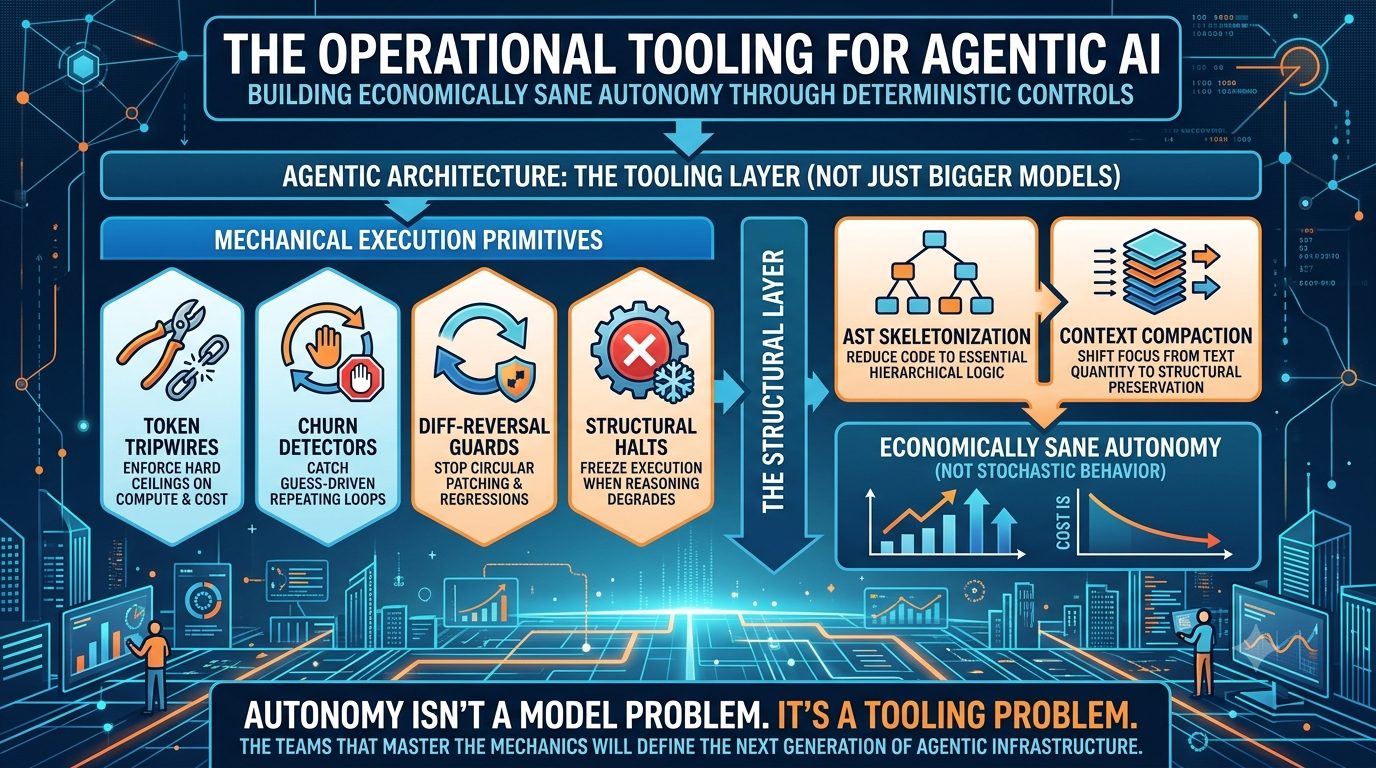
Agentic AI isn’t held back by imagination. It’s held back by tooling.
The industry keeps trying to scale autonomy by scaling models. The real leverage comes from the mechanical systems wrapped around them. The teams that win won’t be the ones with the biggest models. They’ll be the ones with the best tooling discipline.
The mechanical tools
The most underrated tools in agentic architecture are the mechanical ones:
- Token tripwires enforce hard ceilings on spend, so a run stops at a set limit instead of at a surprise invoice.
- Churn detectors catch guess-driven loops, where an agent keeps trying variations without making progress.
- Diff-reversal guards stop circular patching, where one edit undoes the last and the agent never converges.
- Structural halts freeze execution when reasoning degrades, so a bad run stops instead of compounding.
These aren’t safety features bolted on at the end. They’re execution primitives. They turn stochastic behavior into bounded workflows, and they make autonomy economically sane.
The structural layer
Then there’s the structural layer: AST skeletonization and context compaction.
These tools matter because they change the question. It stops being “How much context can we afford?” and becomes “How much structure can we preserve?”
When agents operate on structure instead of raw text, small models behave as if they have global awareness. That isn’t a trick. It’s a tooling philosophy.
Where this leaves us
The future of agentic AI will be shaped by founders and engineers who understand one thing: autonomy isn’t a model problem. It’s a tooling problem.
The teams that master the mechanics, the tripwires, the skeletonizers, and the compaction engines, will define the next generation of agentic infrastructure.
Originally shared on LinkedIn.